If you’ve applied to dozens of jobs and heard back from almost none of them, it’s easy to assume the market is just brutal right now, or that you’re somehow not qualified enough. Sometimes that’s part of the story — application volumes have surged in recent years, with one 2025 report noting a 207% jump in applications for business roles and 161% for technical roles since 2021. More applicants per posting genuinely does make the pile deeper.
But far more often, the actual cause of the silence is more fixable than it feels: a handful of specific, identifiable problems compounding on top of each other. Across the hundreds of client searches we’ve managed, these are the ones that recur — listed roughly in order of how much they matter.
Problem #1: The Resume Gets Lost or Misread Before a Human Engages
This is the foundational issue, and it’s invisible from the outside — you have no way of knowing whether a human ever properly saw your application. Two things happen here, and it’s worth separating them, because the popular version is half wrong.
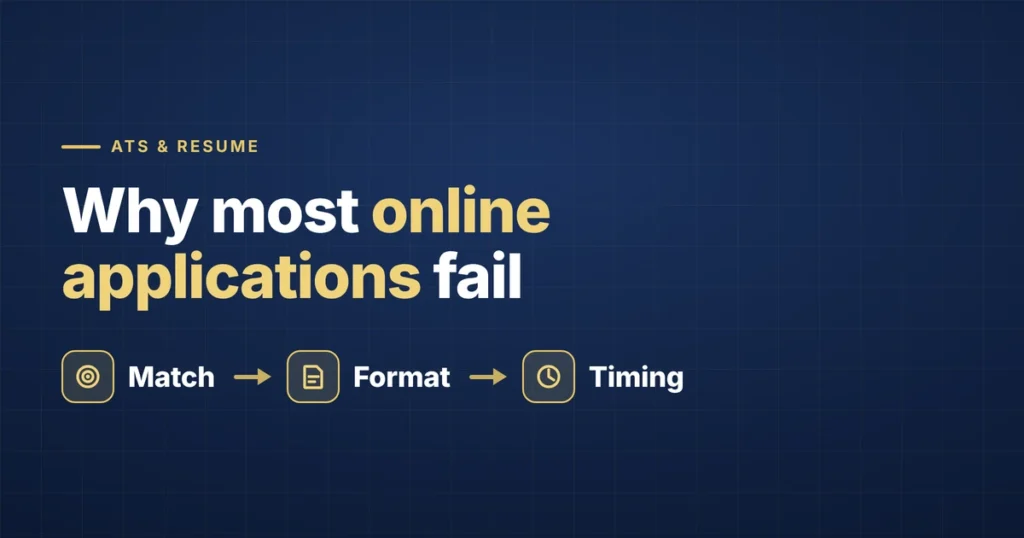
The popular version says an ATS “rejects” you. In reality, recent recruiter data shows only about 8% of recruiters configure content-based auto-rejection; most applications are reviewed by a human. So the failure usually isn’t outright rejection — it’s that your qualifications got misread by the parser (formatting issues, information in headers, graphics standing in for text), or you got out-ranked and out-waited in a pile of hundreds. High-demand roles draw 400 to 2,000+ applicants within days, and many recruiters review in arrival order and pause postings after a few hundred strong candidates. A perfectly good application that lands in week three can simply never be reached.
Fix first: Run your resume through the formatting and tailoring checks in our resume review checklist before anything else, and apply early when you can. This is the highest-leverage fix because formatting affects every single application you send. (The format rules themselves are in our ATS-friendly resume guide; the full mechanism is in why your resume gets rejected, and the specific parsing traps are in ATS resume mistakes.)
Problem #2: One Resume, Sent Everywhere
Sending the identical resume to fifty postings feels efficient, but it’s often the single biggest reason for silence. Each posting weights different keywords, emphasis, and requirements — and a generic resume matches none of them particularly well, even when the underlying experience would actually be a strong fit.
The numbers make the case bluntly. A 2024 analysis of over a million applications found that aligning your resume title with the job title raised interview rates roughly 3.5x. Broader analyses put tailored applications at a 7–9% interview rate versus 2–3% for generic ones — meaning a tailored application is worth roughly two to three generic ones. And in a 2025 TopResume survey, most recruiters flagged failure to tailor as a top mistake, so it costs you with the human reviewer too.
Fix: At minimum, adjust your summary and top bullet points to reflect each posting’s specific language before submitting. This doesn’t require rewriting the whole document — just enough targeted adjustment to actually match what’s being asked for. (Step-by-step in how to pass ATS screening.)
Problem #3: Applying to Roles That Aren’t a Real Match
Volume-based applying — sending out as many applications as possible regardless of fit — produces a lot of activity and very little result. If you’re applying to roles where your background is only loosely related, you’re competing against candidates who are a much closer match, and no amount of resume polish changes that math. A useful recruiter rule of thumb: apply where you meet roughly 70% or more of the stated requirements, not 30%.
Fix: Before applying, honestly assess whether your background addresses the core requirements of the posting — not just the title, but the actual responsibilities listed. A smaller number of well-matched applications consistently outperforms a larger number of loosely-matched ones. (We unpack why in why mass-applying doesn’t work.)
Problem #4: No Cover Letter, or a Generic One
Many job seekers skip the cover letter, assuming it doesn’t matter. Others write one generic version and swap in the company name. Both waste an opportunity: a cover letter that actually references the specific role and connects your background to it can meaningfully differentiate you from candidates who didn’t bother — especially when a posting explicitly requests one, and especially in a deep applicant pool where most people send nothing.
Fix: When a posting asks for a cover letter, or when the role is a genuinely strong match, write a short, specific, three-paragraph letter tailored to the role. Skip it only when it’s clearly optional and the role is a long shot.
Problem #5: A Weak or Outdated LinkedIn Profile
Increasingly, a recruiter interested in your application will check your LinkedIn before reaching out — or find you through LinkedIn search before you even apply. A thin, outdated, or poorly-optimized profile can undercut an otherwise strong resume, or keep you invisible in recruiter searches in the first place.
Fix: At minimum, make sure your LinkedIn headline and About section reflect your current target role, not just your current job title. (See LinkedIn headline examples and how recruiters actually search LinkedIn.)
Putting This Together
These problems compound. A resume that’s ATS-friendly but not tailored still underperforms. A perfectly tailored resume for a role that’s a poor fit still won’t convert. A strong resume undercut by an empty LinkedIn profile leaks opportunities before an interview is ever offered.
The candidates who get consistent traction usually aren’t doing any one of these things perfectly. They’re doing all of them reasonably well — applying carefully rather than constantly, treating each application as worth the extra ten minutes it takes to actually fit. This is also why a deliberate, consistent process tends to beat raw effort over a multi-week search: quality erodes somewhere around application number forty when you’re doing it all alone, on top of everything else in life.
If the problem isn’t knowing what to fix but finding the hours to do it on every application, you can also hire someone to apply for jobs for you — the same checks, run for you on each submission.
Frequently Asked Questions
Why do I never hear back from job applications?
The most common reasons, in order: your resume’s formatting made your qualifications hard to parse; you applied late to a posting that already had hundreds of applicants; your resume wasn’t tailored to the specific role; or the role wasn’t a strong match for your background. Note that “no response” usually means you were out-ranked or never reached — not that a bot deleted you.
Is it the ATS rejecting me or a human?
Usually a human, or simply no one at all. Recent recruiter data shows only about 8% configure their ATS to auto-reject on content; most applications are human-reviewed, and the biggest hurdle is volume. The fixable parts are formatting (so you parse correctly), tailoring (so you rank and read well), and timing (so you’re in the pile that gets reviewed).
How many applications is normal before getting an interview?
There’s no universal number, but tailored applications convert at roughly 7–9% versus 2–3% for generic ones — so a dozen-plus well-targeted applications per interview is more realistic than the hundreds many people send. If you’re well past 50 tailored, well-matched applications with zero traction, the issue is more likely targeting or formatting than needing to apply to even more. (Full detail in how many job applications it takes.)
Does applying early actually matter?
Yes, more than most people realize. Over half of recruiters review applications in the order they arrive, and many pause a posting after a few hundred strong applications even while it stays live. Applying within the first few days of a posting meaningfully improves the odds your application is actually seen.
The Bottom Line
These problems compound, but they’re also all fixable, and most don’t require talent or luck — just attention. The candidates who get traction apply carefully rather than constantly, fix the formatting that hides their qualifications, tailor to roles they actually fit, and apply early enough to be seen.
If doing all of that consistently, for every application, is more than you can manage alongside your actual job search, that’s the exact problem we solve — targeted, tailored, tracked applications so each one is built to get seen. See how it works or get started.