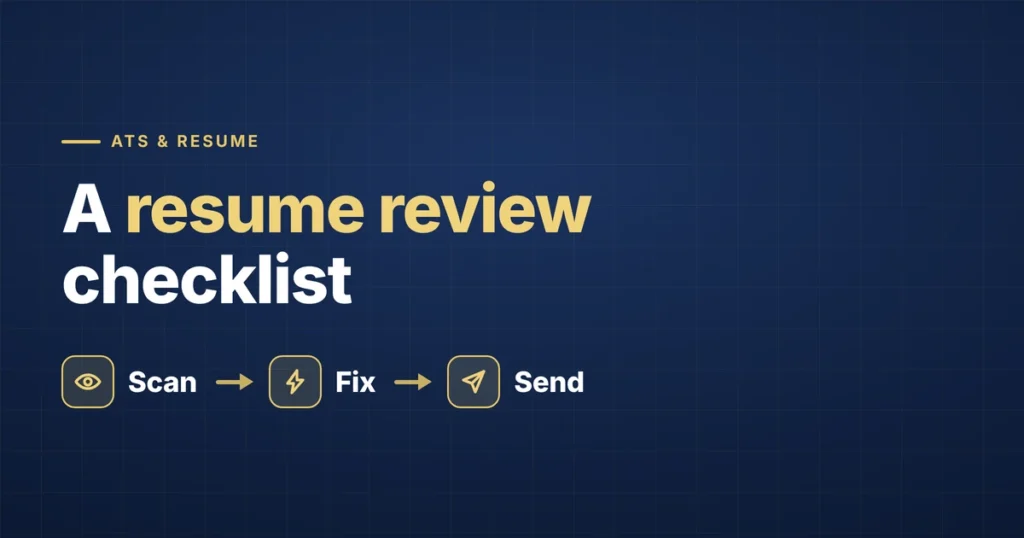
Before you hit submit on any application, run through this checklist. It takes about five minutes and catches the mistakes that most commonly cost people interviews — not because they weren’t qualified, but because something small got in the way.
Why bother every time? Because the failure mode here isn’t never checking your resume — it’s checking it once, months ago, and trusting that last week’s version is still right for this week’s role. Given that tailored applications convert to interviews at roughly 7–9% versus 2–3% for generic ones, a five-minute pass per application is one of the highest-return habits in a job search. (For the full reasoning, see why your resume gets rejected.)
Formatting Checks
- Single-column layout — no tables, no text boxes, no graphics
- Standard font (Arial, Calibri, Georgia, or Times New Roman), sized 10–12pt
- Standard section headers: “Experience,” “Skills,” “Education” — not creative alternatives
- Contact information is in the body of the document, not a header or footer
- File saved as both .docx and .pdf, and both versions open and display correctly
- Length matches your experience level: roughly one page early-career, one to two mid-career, up to two or three senior/executive
Content Checks
- Every bullet starts with a strong action verb (Led, Built, Drove, Managed, Optimized) — not “Responsible for”
- At least one quantified result per role where possible — a percentage, dollar amount, or timeframe
- Your professional summary contains at least one real keyword or achievement from the posting — if it doesn’t, rewrite it or cut it
- Skills are listed as plain text, not graphics, bars, or star ratings
- Every role has clearly visible start and end dates
- No unexplained gaps longer than a few months without at least a brief, honest framing
Tailoring Checks (Do This for Every Application)
- You’ve copied the actual job description and identified its specific required tools, certifications, and key phrases
- Your resume uses the same specific language as the posting — not a synonym you’re hoping the system recognizes
- Your top 2–3 bullet points across your most recent roles reflect what this specific job is asking for, not just your strongest general accomplishments
- You’ve removed or de-emphasized experience that isn’t relevant to this particular role
Final Read-Through
- Read the entire resume out loud once — awkward phrasing is much easier to catch by ear than by eye
- Check for consistent date formatting (e.g., “Jan 2022” throughout, not a mix of “January 2022” and “01/2022”)
- Confirm zero spelling or grammar errors — run a spell-checker, then read it manually anyway (an ATS won’t catch typos, but the recruiter who reads next will)
- Ask: if a recruiter only read the top third of this page in their brief first scan, would they understand who you are and why you’re a fit?
A 30-Second ATS Test
Before submitting anything important: copy your resume’s text and paste it into a plain text editor like Notepad. If the sections stay in order and nothing disappears, an ATS will likely parse it cleanly. If text scrambles or merges, fix the formatting first. (Free scanners like Jobscan or Resume Worded do the same check and flag missing keywords.)
If the test fails, the fix is structural rather than cosmetic — the layout rules that make a resume parse correctly are set out in our ATS-friendly resume guide.
Why This Matters More Than It Seems
None of these individual checks are complicated. The value isn’t in any single item — it’s in running through the entire list, every time, instead of trusting that last week’s version is still good enough. The candidates who get consistent interview traction tend to treat this as a five-minute habit, not an occasional audit. It’s also exactly the kind of consistency that’s hard to sustain solo across a long search — quality quietly slips somewhere around application forty when you’re doing everything alone. (More on that pattern in what we’ve learned helping 500+ job seekers.)
Frequently Asked Questions
How do I check if my resume is good before applying?
Run a structured pass: confirm clean single-column formatting, action-verb bullets with at least one metric per role, a summary containing the posting’s keywords, and that your top bullets match the specific role. Then do a 30-second ATS test by pasting the text into Notepad to confirm it parses cleanly. The full checklist above covers each step.
What should I check on my resume before submitting?
Formatting (single column, standard fonts and headers, contact info in the body), content (quantified, action-verb bullets), tailoring (the posting’s exact language in your summary and top bullets), and a final proofread out loud. Save and verify both .docx and .pdf versions.
How long should reviewing my resume take?
About five minutes per application once your base resume is built. Most of that time goes to the tailoring checks — adjusting your summary and top bullets to match the specific posting — which is where most of the interview-rate benefit comes from.
Do I really need to tailor my resume for every job?
Yes, if you want the best odds. Tailored applications convert at roughly 7–9% versus 2–3% for generic ones, and a majority of recruiters in a 2025 survey flagged failure to tailor as a top mistake. It doesn’t mean rewriting everything — just adjusting your summary, skills, and top bullets to each role.
The Bottom Line
This checklist exists to catch the small, fixable things that quietly cost qualified people interviews. Run it every time, treat the tailoring section as non-negotiable, and you’ve removed most of the self-inflicted reasons applications go unanswered.
If running this on every single application is more than you can keep up with alongside your job search, that’s precisely what we do — every application built to pass these checks before it goes out. See how it works or get started.