You’ve applied to dozens of roles. Maybe more. The responses range from a templated rejection weeks later to the more common outcome: nothing at all. At some point the explanation you’ve probably landed on is some version of “a robot rejected me before a human ever saw it.”
It’s the most repeated claim in job-search advice, and it’s worth starting here because it’s mostly wrong — and believing it sends people in exactly the wrong direction. After managing applications for hundreds of job seekers and watching what actually happens after we hit submit, we’ve seen the real reasons applications fail, and they’re more fixable than the myth suggests. Here’s what’s actually going on, and what to fix first.
First, the Myth Worth Killing: “75% of Resumes Are Auto-Rejected by ATS”
You’ve seen this statistic. It’s everywhere — career blogs, LinkedIn posts, the marketing copy of every resume tool. “75% of resumes are rejected by an Applicant Tracking System before a human ever sees them.”
There’s one problem: no credible research supports it. The number has been traced back to a 2012 sales pitch by a company called Preptel, which went out of business in 2013 without ever publishing a methodology. Career consultant Christine Assaf investigated the claim and concluded it was created without any study, survey, or context. It survived purely because it makes a compelling headline — and because it’s useful to anyone selling a fix.
What does the actual recent data show? It’s more nuanced, and more useful:
- When Enhancv interviewed 25 U.S. recruiters across tech, healthcare, and finance in late 2025, only 2 of them (8%) had configured their ATS to auto-reject resumes based on content or match score. The other 92% either review manually or use simple “knockout” filters.
- Recruiter Jan Tegze estimates that 90–95% or more of all applications are actually reviewed by a human at some point.
- Researchers who spoke with recruiters at Amazon, Google, and Microsoft found that none of the major ATS platforms automatically reject or hide resumes from recruiters.
So if a piece of software isn’t silently deleting your application, why does it so often disappear into silence? The answer is less dramatic but more important to understand.
What’s Actually Happening: Volume, Ranking, and Human Bandwidth
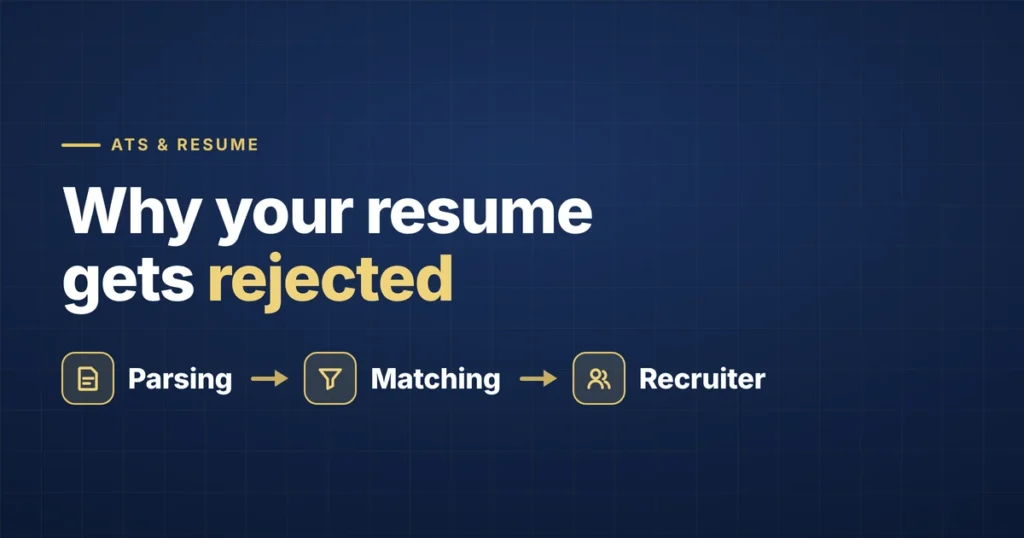
Modern Applicant Tracking Systems — Workday, Greenhouse, Taleo, iCIMS — mostly do two things: they parse your resume (extract its text into structured fields) and they rank it against a search query. The critical word is rank, not reject. The ATS puts your resume in an ordered list. A human then decides how far down that list they’re willing to read.
And here’s the part that actually determines your outcome: that list is long. High-demand roles routinely attract 400 to over 2,000 applicants within days of posting. Many recruiters pause a listing after 300–500 strong applications even while it stays live online. More than half of recruiters review applications in the order they arrive. So a strong application submitted in week three of a posting may sit beneath hundreds of others that arrived first — never rejected, just never reached.
This reframes the entire problem. Your resume usually isn’t failing a secret algorithmic test. It’s competing for a slice of limited human attention, against a large pile, where being findable, relevant, and early matters more than gaming any bot.
That said — the parsing step is real, and it’s where genuinely qualified people quietly lose. Harvard Business School’s “Hidden Workers” study found that 88% of employers acknowledged that qualified candidates were being filtered out by their own hiring software’s configuration. Not because the candidates lacked skills — because the system, set up by a human, couldn’t see them. So the goal isn’t to “beat the ATS.” It’s to make sure your real qualifications survive being read by a machine, and then earn human attention once they do.
With that framing, here are the actual reasons applications fail, in rough order of how much they matter.
Reason #1: The Resume Parses Badly (Your Qualifications Become Invisible)
This is the foundational, invisible failure. If an ATS can’t cleanly extract your information, it doesn’t matter how strong your background is — the structured fields a recruiter searches against come back empty or scrambled.
The usual culprits are design choices that look polished to a human and break for a parser:
- Multi-column layouts. Many parsers read left-to-right across the full page, splicing your two columns into nonsense.
- Information in headers and footers. Some systems skip these entirely. Put your name, phone, and email there, and the system may register your application as missing contact details.
- Tables, text boxes, and graphics. A skills bar showing “Excel: ●●●●○” is, to a parser, zero text. The skill simply doesn’t exist in your file.
Fix first: Strip the resume to a single-column, plain-text-friendly structure with standard section headers. This is the single highest-leverage fix because it affects every application you send, and it’s a formatting pass, not a rewrite. (Our ATS-friendly resume template is built in exactly this structure, and the ATS mistakes guide covers each parsing trap in detail.)
Reason #2: One Generic Resume, Sent Everywhere
This is the most common strategic failure, and the data on it is striking. A 2024 analysis of over one million applications found that simply aligning your resume’s title with the job’s title increased interview rates roughly 3.5x. Separate research summarized by job-search analysts puts the gap starkly: tailored applications convert to interviews at roughly 7–9%, versus 2–3% for generic ones — which works out to roughly 12–15 tailored applications per interview, against around 42 generic ones.
Read that again, because it inverts the instinct most job seekers run on. Tailoring isn’t a nice-to-have that marginally helps. By these numbers, a tailored application is worth two to three generic ones. Sending the same resume to fifty postings feels efficient, but each posting weights different keywords and priorities, and a generic resume matches none of them well — even when your underlying experience is a genuine fit.
Importantly, tailoring helps with both gates. It surfaces the right keywords for the parser, and — per a 2025 TopResume survey where over half of recruiters flagged failure to tailor as a top resume mistake — it signals to the human reviewer that you actually read the role.
Fix: For each application, adjust your summary, your skills section, and your top two or three bullet points to mirror the specific posting’s language before you submit. This is 5–10 targeted line-level edits, not a fresh document each time. (More on how to do this in how to pass ATS screening.)
Reason #3: Applying to Roles That Aren’t a Real Match
Tailoring a resume for a role you were never a strong fit for is a better version of a losing hand, not a winning one. If your background only loosely addresses the core requirements, you’re competing against candidates who are a much closer match, and polish doesn’t change that math.
A useful rule that recurs in recruiter guidance: apply to roles where you meet roughly 70% or more of the stated requirements, not 30%. Volume-based applying — firing off as many applications as possible regardless of fit — produces a lot of activity and very little traction. Across our own client work, this is the most consistent pattern we see in people who come to us after months of fruitless searching: high application counts, broad targeting, almost no callbacks. The fix is rarely “apply to more.” It’s “apply to the right ones, properly.”
Fix: Before applying, honestly assess whether your background addresses the actual responsibilities listed — not just the job title. A smaller number of well-matched applications reliably outperforms a larger pile of loosely-matched ones. (We dig into the mechanism in why mass-applying doesn’t work.)
Reason #4: No Cover Letter, or a Generic One
Many candidates skip the cover letter, assuming it’s ignored. Others write one version and swap the company name. Both waste a cheap differentiator: in a pool of hundreds, a genuinely tailored three-paragraph letter that connects your background to this role can separate you from everyone who didn’t bother — especially when a posting specifically requests one.
Fix: When a posting asks for a cover letter, or when the role is a strong match worth the effort, write a short, specific one that references the actual job. Skip it only when it’s clearly optional and the role is a long shot.
Reason #5: A Weak or Missing LinkedIn Profile
A recruiter interested in your application will very often check your LinkedIn before reaching out — and may find you through LinkedIn search before you ever apply. A thin, outdated, or keyword-poor profile undercuts a strong resume, or keeps you invisible in the searches that matter.
Fix: At minimum, make sure your LinkedIn headline and About section reflect your target role, not just your current title. (See LinkedIn headline examples and how recruiters actually search LinkedIn.)
How These Problems Compound
These failures don’t operate in isolation — they stack. A perfectly ATS-readable resume that isn’t tailored still underperforms. A beautifully tailored resume for a poorly-matched role still won’t convert. A strong resume undermined by an empty LinkedIn profile leaks opportunities at the recruiter-research stage.
The candidates who get consistent traction usually aren’t doing any single one of these things perfectly. They’re doing all of them reasonably well — applying carefully rather than constantly, treating each application as worth the extra ten minutes it takes to actually fit. That’s the entire thesis, and it’s also exactly why a deliberate, consistent process tends to beat raw individual effort over a multi-week search, when fatigue inevitably erodes quality somewhere around application number forty.
Frequently Asked Questions
Do Applicant Tracking Systems automatically reject resumes?
Mostly no. Recent recruiter data shows only about 8% of recruiters configure their ATS to auto-reject based on content, and the large majority of applications are ultimately reviewed by a human. The main exceptions are explicit “knockout” filters that recruiters set deliberately — things like work authorization status or a required certification — not hidden algorithmic judgments about your worth.
So is “ATS optimization” pointless?
No — but it’s misframed. The point isn’t to trick a bot into approving you. It’s to make sure a parser can correctly read your real qualifications into the fields a recruiter searches, and that your resume uses the specific language of the role. Clean formatting plus genuine tailoring covers the overwhelming majority of what matters.
Why do I get rejected when I’m clearly qualified for the role?
The two most common reasons are parsing failures (your qualifications are on the page but the software couldn’t extract them) and volume (you applied after the recruiter had already gathered enough strong candidates). Harvard Business School research found 88% of employers acknowledge qualified candidates get filtered out by their own systems’ configuration. Applying earlier and fixing formatting both directly address this.
How many applications should it take to get an interview?
There’s no universal number, but tailored applications convert at roughly 7–9% versus 2–3% for generic ones — so somewhere in the range of a dozen-plus well-targeted applications per interview is a more realistic expectation than the hundreds many people send. We cover this in depth in how many applications it actually takes.
What’s the single most important fix?
If you only change one thing, fix your resume’s formatting so it parses cleanly — single column, standard headers, no graphics or tables, contact info in the body. It’s the one fix that improves every application you send. After that, tailoring each application is the highest-leverage habit.
The Bottom Line
Your resume probably isn’t being eaten by a secret algorithm. It’s more likely getting lost in a large pile, filtered out by a formatting issue that hid your qualifications, or quietly mismatched to roles and postings it was never written for. None of that is a verdict on whether you’re good enough. It’s a set of specific, fixable problems — and knowing which one is actually costing you is the difference between applying harder and applying smarter.
If working through these fixes yourself feels like one more full-time job on top of your actual job search, that’s precisely the problem we exist to solve: we handle the targeting, tailoring, and tracking so every application that goes out has actually been built to get seen. You can see how our process works or start here.