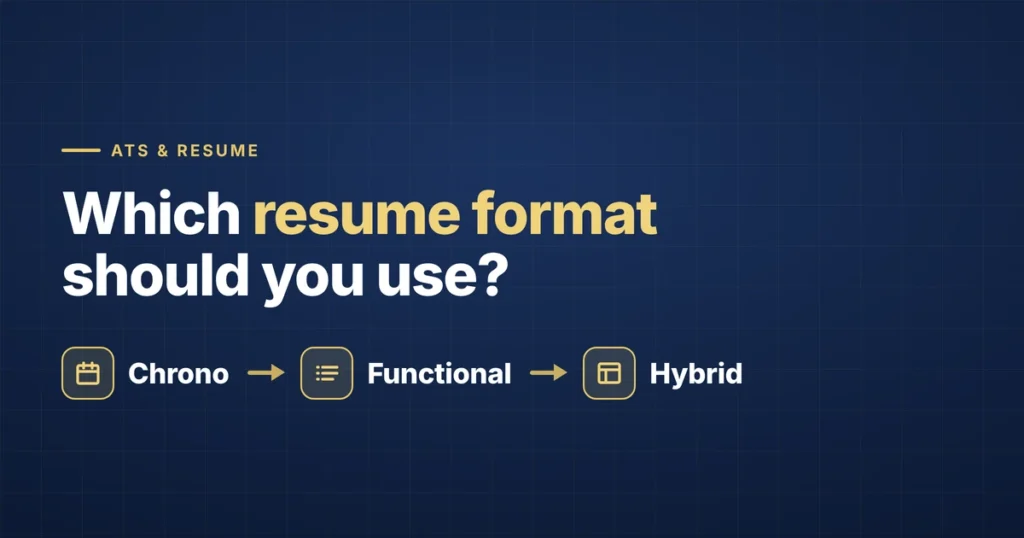
Before you write a single bullet point, you need to decide on a structure. The three main resume formats — chronological, functional, and hybrid — aren’t just stylistic choices. They have real, practical implications for how ATS systems read your resume and how recruiters interpret your background during a brief first scan.
Here’s the short version up front, then the detail: for the overwhelming majority of job seekers, chronological or hybrid is the right call, and fully functional resumes carry real ATS risk. Here’s why.
Quick Comparison
| Best for | ATS reliability | Main risk | |
|---|---|---|---|
| Chronological | Steady, relevant history, no major gaps | High — parses most predictably | Exposes gaps plainly |
| Functional | Severe gaps or full career change | Low — can be flagged or auto-rejected | Missing dates trigger suspicion |
| Hybrid | Gaps or pivots, want to lead with skills | High — chronological backbone intact | Slightly longer to write well |
Chronological Format
The most common format, and for most candidates the right default. Your work history is listed in reverse order — most recent role first — with employment dates clearly attached to each position.
Best for: Candidates with a steady, relevant work history and no significant gaps.
ATS impact: High and reliable. This format parses most predictably across virtually every major platform, since it matches the structure these systems are built to expect.
Why it works: Recruiters are used to scanning it quickly. It tells a clear story — where you’ve been, in order, with no guesswork about timeline. During the brief initial scan (studies put this anywhere from ~7 to ~11 seconds), a recruiter can find your most recent title, company, and dates exactly where they expect them.
Functional Format
This format organizes your resume around skill categories rather than a timeline — “Leadership,” “Project Management,” “Technical Skills” — with specific employers and dates pushed to the bottom or minimized.
Best for: Very specific situations — severe employment gaps, or a significant career change where your most relevant experience doesn’t come from your most recent title.
ATS impact: Moderate to low. This is the format to be most cautious with. Functional resumes de-emphasize dates and chronological history in favor of skill groupings, and a number of ATS systems specifically flag — or even auto-reject — resumes that lack clearly dated work entries.
Why it’s risky: What looks like a clever way to hide a gap can actually trigger a rejection before a human ever has the chance to ask about that gap directly. And recruiters know the format’s reputation; many read a functional resume as “what is this person not telling me?” Unless your situation is genuinely severe — a multi-year gap, or a complete field change with zero relevant recent titles — this format introduces more risk than it solves.
Hybrid Format (Sometimes Called “Combination”)
This format takes the best of both: a brief skills or summary section up top, followed by a standard, fully-dated chronological work history below it.
Best for: Most candidates with some gaps, a career pivot, or a desire to highlight specific skills before diving into full work history — without sacrificing ATS-friendliness.
ATS impact: High. Because the chronological backbone is fully intact, this format retains the parsing reliability of a standard chronological resume while still giving you room to foreground specific skills or a career narrative up top.
Why it’s the safer alternative to functional: If your instinct is to reach for a functional format because of a gap or pivot, a hybrid almost always gets you the same benefit — leading with your strengths — without the ATS risk of omitting or burying dates.
Quick Decision Guide
- Steady, relevant work history, no real gaps: Chronological.
- Significant gap or full career change, want to lead with skills: Hybrid, not Functional.
- Severe, multi-year gap, specifically targeting older or smaller companies less likely to use sophisticated ATS: Functional may be acceptable, but treat it as a last resort, not a default.
A Note on Length, By Format
Whichever format you choose, length should match experience: one page for early-career (0–5 years), one to two pages mid-career (5–15 years), up to two or occasionally three for senior/executive. Format doesn’t change this — a hybrid resume isn’t a license to run long. (More on the structure itself in our ATS-friendly resume template.)
The Bottom Line
For the overwhelming majority of job seekers, chronological or hybrid is the right call. Functional resumes are tempting because they feel like a clever workaround for an awkward history, but the ATS risk is real enough that the format can end up working against you in exactly the situation you were trying to protect yourself in. (This is Mistake #7 in our ATS resume mistakes guide for a reason.)
Frequently Asked Questions
What is the best resume format for ATS?
Chronological or hybrid. Both keep a fully-dated work history that parses reliably across major ATS platforms. Fully functional (skills-only, dates minimized) formats are the riskiest, since some systems flag or reject resumes lacking clear employment dates.
Is a functional resume bad for ATS?
It can be. Functional resumes de-emphasize dates and chronological history, and some ATS systems specifically flag or auto-reject resumes without clearly dated work entries. Unless you have a severe multi-year gap, a hybrid format is almost always the safer choice.
What’s the difference between a hybrid and a chronological resume?
A chronological resume leads straight into dated work history, most recent first. A hybrid adds a brief skills or summary section at the top before that same dated chronological history. The hybrid lets you foreground key skills while keeping the ATS-friendly dated backbone intact.
Which resume format is best for a career change?
Hybrid. It lets you lead with the transferable skills and summary relevant to your new direction, while still showing a complete, dated work history below — giving you the “lead with strengths” benefit of a functional format without the ATS risk.
Ready to Apply This?
The right format is the foundation, but it only matters once each application is also tailored to the specific role. If keeping that up across a full job search is more than you can manage, that’s what we handle. See how it works or get started.