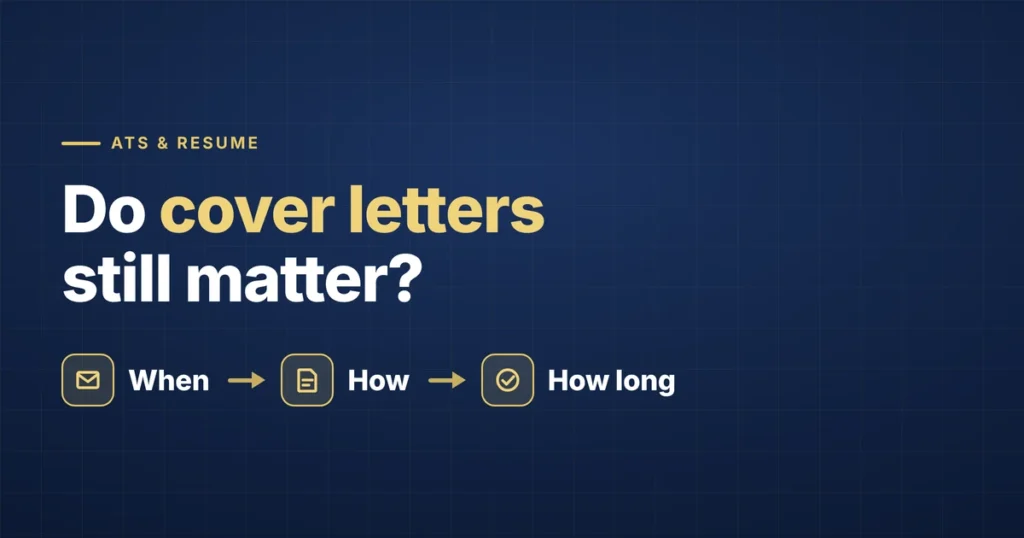
Cover letters still matter — but not for every application. Some recruiters read them closely, many skim them, and some never open them at all. The practical answer is to write one when it’s required, when it can explain something your resume can’t, or when the role is one you really want. For everything else, a strong tailored resume does most of the work.
Here’s how to decide, and how to write a short cover letter that’s worth reading when you do.
When a cover letter matters
Write a cover letter when:
- The posting asks for one. If it’s required, skipping it can disqualify you before anyone reads your resume.
- You’re changing careers. A cover letter can connect your past experience to the new field in a way bullet points can’t.
- You have something to explain. An employment gap, a relocation, or a step down in seniority is better addressed by you than guessed at by a recruiter.
- It’s a small company or a writing-heavy role. Smaller teams and roles in communications, marketing, or editorial work are more likely to read cover letters as a writing sample.
- You have a referral or a genuine connection. Naming the person who referred you, or a specific reason you want this company, adds context.
When you can skip it
It’s usually fine to skip a cover letter when:
- The application doesn’t have a field or upload option for one.
- It’s marked “optional” and you’d only be sending a generic template.
- You’re applying for high-volume roles where speed matters more than narrative.
A generic cover letter can do more harm than good. If it reads like it could be sent to any company, it signals the opposite of interest. When you skip one, make sure your resume summary does the job instead — see our ATS-friendly resume guide.
Customised application vs. template
The difference between a cover letter that helps and one that doesn’t is specificity. A customised application letter:
- Names the exact role and the company.
- Refers to one or two specific requirements from the job description.
- Gives one concrete example proving you can meet them.
- Mentions something real about the company — a product, a market, or a goal from the posting.
A template letter does none of these and replaces specifics with phrases like “I’m a hard-working team player.” You can start from a structure, but every sentence that matters should be written for that job.
A short cover letter structure that works
Aim for 200–300 words in three or four short paragraphs:
- Opening (2–3 sentences): the role you’re applying for and the single strongest reason you’re a fit. Skip “I am writing to apply for…”
- Proof (3–5 sentences): one specific achievement that matches the posting’s top requirement, with a result if possible.
- Fit (2–3 sentences): why this company or role specifically, or a brief explanation of a gap or career change.
- Close (1–2 sentences): a simple statement that you’d welcome a conversation. No need for anything elaborate.
Example opening
“I’m applying for the Customer Success Manager role at [Company]. Over the past four years I’ve managed a portfolio of 60 mid-market accounts and kept renewal rates consistently above target — the retention focus your posting emphasizes.”
Notice what it does: it names the role, leads with evidence, and ties that evidence to the posting — in two sentences.
Cover letters and ATS
When you upload a cover letter, the applicant tracking system usually stores it with your application. Use the same formatting rules as your resume: a plain, text-based file, no graphics, and the job description’s key terms where they fit naturally. Make sure the facts — titles, dates, and employers — match your resume exactly.
The bottom line
Your resume and the role match do most of the work in getting interviews. A cover letter is a tool for specific situations: required fields, career changes, gaps, and roles you care about most. Use it when it adds something, and make it specific when you do.
If you’re sending lots of applications without results, the issue is usually targeting rather than the cover letter. See why most online job applications fail, or let us handle tailored applications for you — here’s how that works.
Frequently asked questions
Do recruiters actually read cover letters?
Some do and some don’t. It varies by recruiter, company size, and role. Cover letters are more likely to be read for competitive roles, small companies, and writing-heavy positions, and when a candidate’s resume raises a question. Because you can’t know in advance, write one whenever it’s required or adds context.
How long should a cover letter be?
Keep it to 200–300 words in three or four short paragraphs, which fits comfortably on less than one page. Lead with your strongest qualification, back it up with one specific achievement, explain why you want this role, and close briefly. Shorter and specific beats longer and generic.
Is it okay to skip an optional cover letter?
Yes, if you’d only be sending a generic template. An optional cover letter is worth writing when you can make it specific to the role, explain a career change or gap, or mention a referral. Otherwise, put that effort into tailoring your resume.