If you’re searching “help me get a job,” you’ve probably already tried the obvious route — applying online — and it hasn’t worked yet. The good news is that there’s more help available than most people realize, and a lot of it is free. The key is matching the type of help to the actual problem holding your search back.
Below is every realistic option, what each one is good for, and how to decide where to start.
First, figure out what kind of help you need
“I need help getting a job” can mean very different things. Before choosing where to go, identify which of these sounds most like you:
- “I don’t know what to apply for.” You need direction — career counseling or coaching.
- “I apply a lot but hear nothing back.” Your resume or targeting is the problem — you need resume and application help.
- “I get interviews but no offers.” You need interview preparation.
- “I don’t have time to apply properly.” You need someone to take over the applying.
- “I need any job, quickly.” You need employers who hire fast — see the fastest way to get a job.
Most people jump straight to applying harder. But if applications aren’t producing responses, sending more of the same just produces more silence. We explain why in why most online job applications fail.
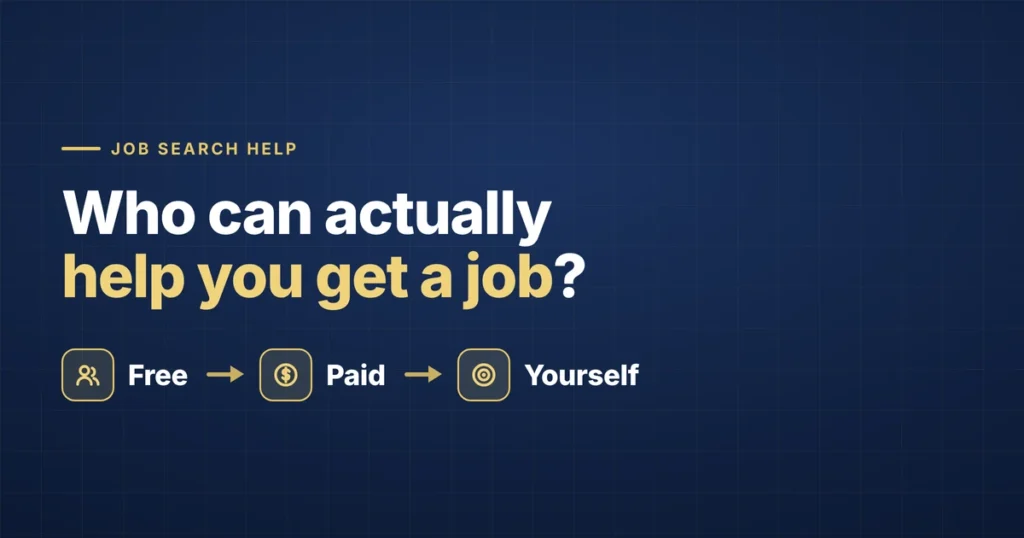
Who can help me get a job for free?
American Job Centers
Every U.S. state runs public career centers, often called American Job Centers, funded by the Department of Labor. They offer free resume reviews, job search workshops, career counseling, and sometimes funding for training. You can find your nearest one through CareerOneStop. If you’ve searched “places near me that help me get a job,” this is the first place to look.
College and alumni career services
If you attended a college or university, check whether its career office serves alumni. Many do, often for free, and they can connect you with alumni working at companies you’re targeting.
Recruiters and staffing agencies
Recruiters and staffing agencies are paid by employers, so their help is free to you. The catch: they work for the employer, so they’ll only invest in you if you fit an opening they’re currently filling. Staffing agencies are especially useful if you need work quickly, since many place people in temporary or temp-to-hire roles.
Nonprofits and community organizations
Local workforce nonprofits, libraries, and community organizations often run free job clubs, resume help, and programs for specific groups such as veterans, career changers, and people returning to work.
Your own network
Former coworkers, managers, and classmates are some of the most effective help available. A short, specific message — the role you’re targeting and one company you’d love an introduction to — works far better than “let me know if you hear of anything.”
Paid job application assistance
Free resources are a good start, but they’re usually limited in time and depth. Paid help is worth considering when you need more hands-on support:
- Resume writers rebuild your resume once. Good if your resume is the main problem.
- Career coaches help with direction, positioning, salary negotiation, and interviews.
- Job application services find matching roles, tailor your resume to each one, and apply for you. Good if time is the bottleneck. We explain how these work in can you hire someone to apply for jobs for you?
Whichever you choose, be cautious of anyone who promises a guaranteed job. Paying for help is normal; paying for a guaranteed outcome is a red flag. See do you have to pay to get a job? for the warning signs.
How to help yourself find employment faster
Whatever outside help you use, these fixes make the biggest difference to your own results:
- Narrow your targets. Pick two or three job titles you’re clearly qualified for. A focused search beats a scattered one.
- Tailor every resume. Mirror the job description’s wording for skills and tools you genuinely have. Our guide to ATS-friendly resumes covers the format rules.
- Apply early. Prioritize postings from the last few days rather than ones that have been up for weeks.
- Fix your LinkedIn profile. Recruiters search LinkedIn constantly. Start with how recruiters actually search LinkedIn.
- Track everything. Keep a simple list of every application, date, and follow-up, so you can see what’s working.
Where to start today
If you don’t know where to begin, do this: book a free session at your local American Job Center, update your LinkedIn headline, and apply to three well-matched, recently posted roles with a tailored resume. That’s more effective than sending thirty generic applications.
And if what you really need is someone to take the applying off your hands, see how our service works.
Frequently asked questions
Can someone help me find a job?
Yes. Free help is available from American Job Centers, college career offices, recruiters, staffing agencies, and community nonprofits. Paid options include resume writers, career coaches, and job application services that apply for you. The right choice depends on whether your main problem is direction, your resume, interviews, or time.
Are there people who help you find jobs for free?
Yes. Public American Job Centers offer free career counseling and resume help in every U.S. state. Recruiters and staffing agencies are also free to job seekers because employers pay their fees, although they only help if you fit an opening they’re filling.
I need help getting a job. Where do I start?
Start by identifying why your search is stuck: unclear direction, no responses, failed interviews, or lack of time. Then match the help to the problem. If you’re getting no responses, fix your resume and targeting before sending more applications, since more of the same rarely changes the result.