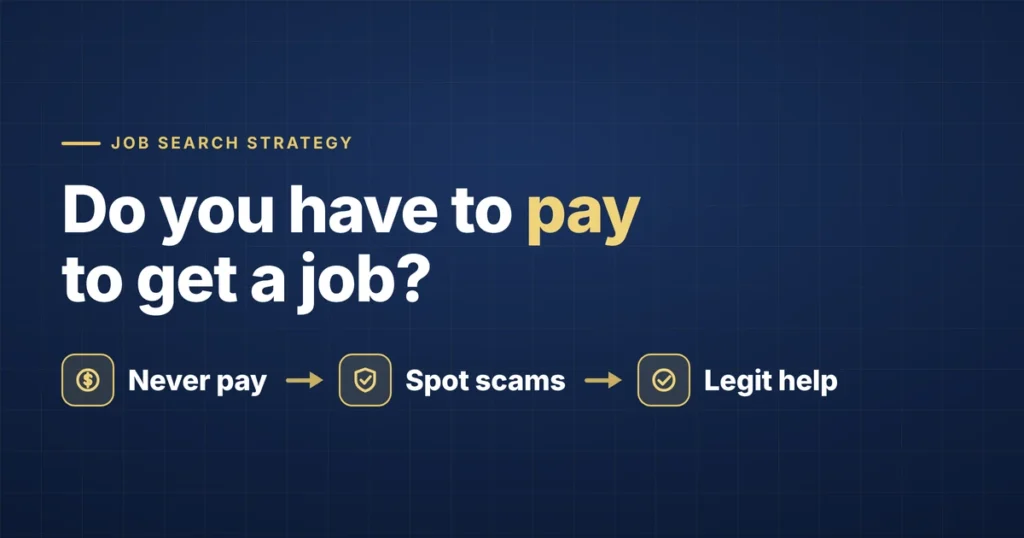
No — you should never have to pay an employer to get a job. Legitimate employers don’t charge you to apply, to be hired, or to start work. If a “job” requires you to pay for training, equipment, a background check, or a placement fee before you’re hired, treat it as a likely scam.
That’s different from paying for job search help, such as a resume writer, a career coach, or a service that applies to jobs for you. Those are legitimate services, as long as they’re honest about what they can and can’t deliver. Here’s how to tell the difference.
Paying an employer vs. paying for a service
| Paying an employer | Paying for job search help | |
|---|---|---|
| What you pay for | The job itself, training, equipment, or “processing” | A defined service: resume writing, coaching, or submitted applications |
| Who decides if you’re hired | Supposedly the person you’re paying | The employer — the service only improves your chances |
| Legitimate? | Almost never | Yes, when the scope is clear and no outcome is guaranteed |
The clearest rule: pay for work done for you, never for a promise of a job. The U.S. Federal Trade Commission gives the same advice in its guide to job scams.
Can you buy a job?
Not legitimately. Nobody outside an employer can sell you a position at that employer. Offers to “buy” a job — or to secure a guaranteed placement in exchange for a fee — are a well-known scam pattern. What you can pay for is better preparation and more, better-targeted applications, which raise your odds of being hired on your merits.
Common job scams to watch for
- Upfront fees for training or equipment. A real employer that requires equipment provides it or reimburses you.
- Fake check scams. You’re sent a check, asked to deposit it, and told to send part of the money elsewhere. The check bounces and you lose what you sent.
- Reshipping jobs. You receive packages at home and forward them. The goods are often bought with stolen cards.
- Interviews only by chat. Hiring that happens entirely over text or a messaging app, with an instant offer and no video or phone conversation, is a strong warning sign.
- Requests for sensitive data too early. Your bank details or Social Security number belong in onboarding paperwork after a verified offer, not in an initial application.
- Guaranteed placement services. Any firm that guarantees you’ll be hired is promising something it doesn’t control.
Before you accept an offer, verify it: find the company’s official website independently, confirm the role is listed on its careers page, and check that the recruiter’s email domain matches the company.
What legitimate job application assistance looks like
Paid help is legitimate when it’s transparent. A trustworthy service should:
- Define the scope clearly — how many applications, resumes, or sessions you get, and over what time frame.
- Show you what it did — which companies and roles it applied to, and when.
- Use only accurate information — no invented jobs, degrees, or skills.
- Make no guarantee of employment — only honest claims about the work it performs.
- Publish its pricing and refund terms before you pay.
That’s the standard we hold ourselves to: our pricing lists exactly how many tailored applications each plan includes, and every application is tracked so clients can see where they’ve applied. For a full breakdown of how these services work, see can you hire someone to apply for jobs for you?
Free alternatives before you pay anyone
You don’t have to pay for help at all. Public American Job Centers offer free career counseling and resume reviews, and recruiters and staffing agencies are free to job seekers because employers pay them. We list every free option in where to get real help finding a job.
Paying for help makes sense when your time is limited or free resources haven’t moved your search forward. Paying for a guaranteed job never does.
Frequently asked questions
Is it legal to pay someone to find you a job?
Yes. Paying for job search services such as resume writing, career coaching, or application assistance is legal. Some states regulate employment agencies that charge job seekers fees, so check that a provider is transparent about its terms. What you should avoid is paying anyone who claims they can guarantee you a job.
Do you have to pay for a background check when applying for a job?
Generally, no. Employers typically pay for background checks on candidates they’re considering hiring. Being asked to pay for your own background check, drug test, or training before an offer is a common sign of a job scam, so verify the employer independently before paying anything.
What are the red flags of a paid job service?
Watch for guaranteed job offers or interviews, unclear scope, no record of where applications were sent, pressure to pay quickly, and willingness to invent experience on your resume. A legitimate service publishes its pricing, explains exactly what you get, and only uses accurate information.