Software engineering resumes face a particular ATS challenge: the field changes fast enough that keywords go stale quickly, and “I know React” means something different depending on the version, the patterns, and the surrounding tools a posting actually wants.
There’s also a wrinkle specific to tech hiring worth naming up front. Tech roles draw some of the deepest applicant pools anywhere — and the tailoring effect is even more pronounced here than in other fields. One 2025 analysis found skills-optimized resumes earned around 4.2x more interview callbacks on average, rising to roughly 5.1x for technical roles specifically. So for engineers, getting the keywords right isn’t a minor edge — it’s close to the whole game at the screening stage.
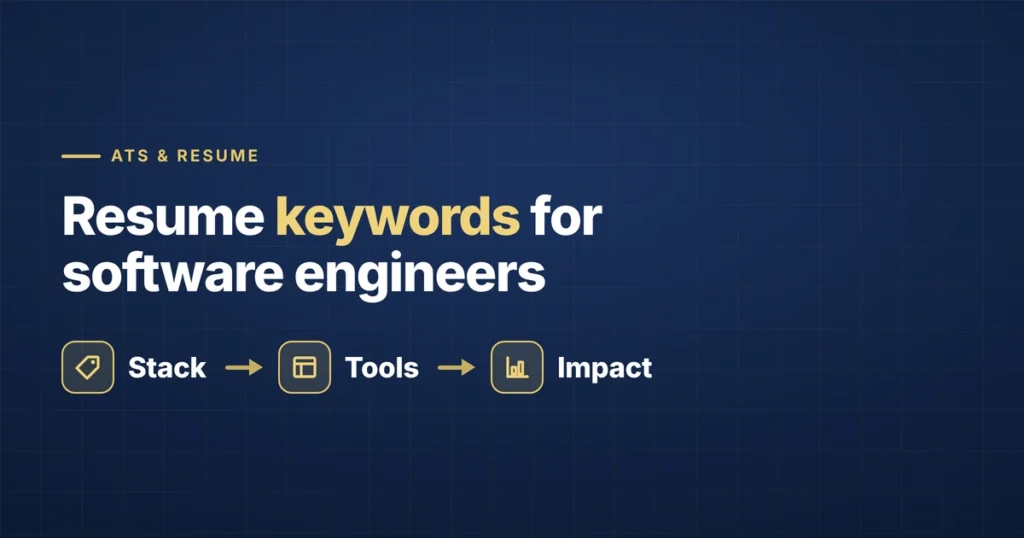
Here are 10 keyword categories that consistently matter in 2026 — and, more importantly, how to use them so they help rather than reading like a list bolted onto your resume. (For the broader mechanics of keyword matching, see how to pass ATS screening.)
1. The Specific Language Versions and Frameworks You Use
Not just “JavaScript” — “JavaScript (ES6+).” Not just “Python” — “Python 3” alongside the specific frameworks (Django, FastAPI, Flask) you’ve actually used. Generic language names still matter, but the specificity signals real, current experience rather than a checkbox.
2. Cloud Platforms, By Name
AWS, Azure, Google Cloud Platform — and ideally the specific services (e.g., “AWS Lambda,” “Azure DevOps,” “Google BigQuery”). A bare “cloud experience” tells an ATS and a recruiter very little; naming the actual platform and service tells them what you can walk into on day one.
3. Version Control and Collaboration Tools
Git, GitHub, GitLab, Bitbucket. Nearly universal at this point, but still worth stating explicitly rather than assuming it’s implied.
4. CI/CD and DevOps Terminology
Continuous Integration, Continuous Deployment, Docker, Kubernetes, Jenkins, Terraform. Even if your role wasn’t DevOps-focused, naming the specific tools you worked alongside (rather than just “deployment experience”) gives the ATS something concrete to match.
5. Database Technologies, Specifically
“SQL” still matters, but specify the actual systems: PostgreSQL, MySQL, MongoDB, Redis. If you’ve worked with both relational and NoSQL databases, say so explicitly rather than letting “databases” stand in for both.
6. Testing and Quality Terminology
Unit Testing, Integration Testing, Test-Driven Development (TDD), Jest, Selenium, Cypress. Quality-focused keywords are increasingly weighted, since they signal a candidate who builds maintainable systems, not just ships features.
7. Agile and Project Methodology Terms
Agile, Scrum, Sprint Planning, Kanban. Pair these with a concrete result where you can — “Led sprint planning for a team of 6 using Scrum, reducing average cycle time by 18%” does far more than the bare term.
8. API and Integration Language
REST API, GraphQL, Webhooks, Microservices. If you’ve built or consumed APIs, name the specific approach rather than a vague “worked with APIs.”
9. Security-Related Terms, Where Relevant
OAuth, Authentication, Encryption, OWASP. Even partial exposure to security practices is worth naming explicitly, since security-conscious language increasingly stands out where it isn’t a given.
10. Soft-Skill Keywords That Still Get Searched
This surprises some engineers, but terms like Cross-Functional Collaboration, Stakeholder Communication, and Mentorship are genuinely searched by recruiters, especially for senior roles. Purely technical skill lists without any collaboration language can actually undersell a candidate above entry level.
How to Use These Without Keyword Stuffing
The mistake to avoid: dropping all ten categories into a “Skills” section as a flat list and calling it done. Modern ATS platforms increasingly use natural-language processing, and unnatural keyword density can get flagged rather than rewarded. Worse, the recruiter who reads next can spot a stuffed resume instantly — one described it as reading “like a job description ran through a blender.” (The hidden-white-text trick is even riskier, since recruiters often paste resume text into a plain document, exposing it.)
The better approach: extract the specific terms from the actual posting you’re applying to, confirm which categories it emphasizes, and weave those terms naturally into your experience bullets — not just your skills list. “Migrated a monolithic service to a microservices architecture using Docker and Kubernetes, reducing deployment time by 40%” does the keyword-matching job and reads like something a human wrote about real work.
Treat this list as a checklist for what to consider per application — not a script to copy onto every resume.
A Note on Freshness
Because this field moves fast, treat any keyword list (including this one) as a snapshot, not gospel. The single most reliable source of the right keywords is always the specific job posting in front of you — it tells you exactly which versions, tools, and methods that team cares about right now. Use category lists like this to make sure you haven’t omitted something you actually have; use the posting to decide what to emphasize.
Frequently Asked Questions
How many keywords should a software engineer’s resume have?
There’s no magic count. Aim to cover the specific tools, languages, and methods named in the posting you’re targeting, woven naturally into your experience bullets and a focused skills section. Most ATS checkers suggest aiming for around 80% alignment with a given posting’s key terms — but accuracy and natural placement matter more than raw quantity.
Where should I put keywords on an engineering resume?
Spread them across your professional summary, skills section, and especially your experience bullets. Keywords embedded in real accomplishment statements (“built X using Y, achieving Z”) score well with parsers and read credibly to humans — far better than a long, context-free skills list.
Do I need different keywords for different engineering roles?
Yes. A frontend role, a backend role, and a DevOps role weight very different terms. Pull the specific language from each posting rather than sending one universal resume — this is where the 4–5x tailoring lift for technical roles comes from.
Will listing a skill I barely know help me pass ATS?
It might surface you, but it backfires fast — technical interviews quickly expose padded skills, and recruiters increasingly verify quantifiable claims. List skills you can actually speak to; specificity about real experience beats a long list of shallow keywords.
The Bottom Line
For software engineers, keywords are the screening game — the tailoring lift is steeper here than almost anywhere else. But the win comes from using the posting’s real terms, woven into real accomplishments, not from stuffing a list. Cover what you have, emphasize what the role wants, and keep it honest enough to survive the interview.
If keeping every application’s keywords aligned to each specific role is more than you can sustain while job searching, that’s the work we handle — tailored, parse-ready applications per role. See how it works or get started.