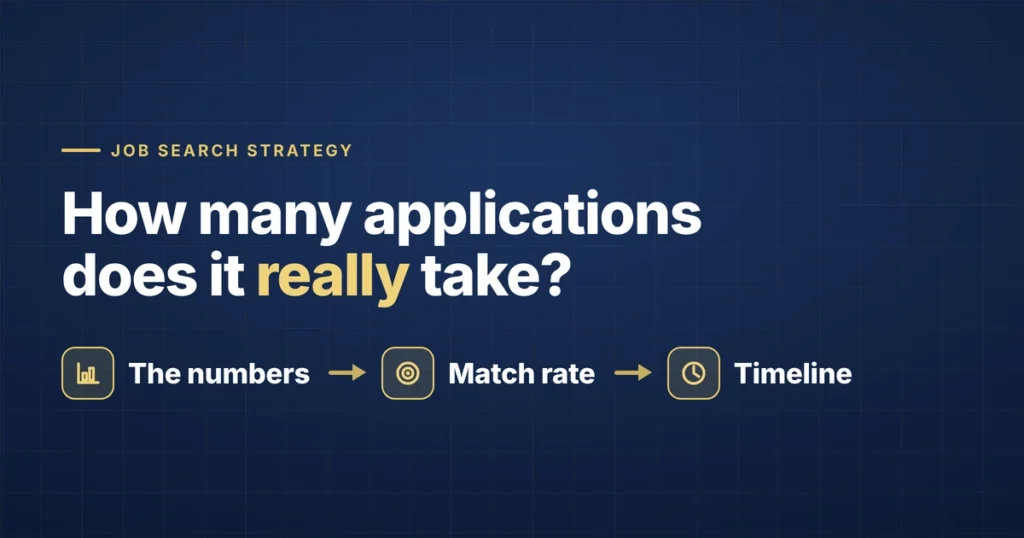
This is one of the most-searched job-search questions, and most answers online either cite a single, suspiciously precise number or recycle an old statistic without checking whether it still holds. The honest answer is messier than one number — but the underlying pattern in the data is more useful than a clean statistic would be anyway.
The Short Answer
There’s no universal number, but the data points in a clear direction: roughly 30 well-targeted, tailored applications per hire for focused job seekers, versus 150–250 or more for generic mass-applying. If you tailor and target properly, expect to need a dozen-plus serious applications per interview — not the hundreds many people send. Here’s what’s behind that.
Why There’s No Single Universal Number
Application-to-interview and application-to-hire ratios vary enormously by industry, role seniority, location, market conditions, and — critically — how targeted the applications are. Reported figures range widely, from as few as ~30 applications for some targeted seekers to 250+ for others. Anyone claiming one universal number without heavy qualification is oversimplifying a genuinely variable picture.
What the Data Does Show (and It’s Consistent)
Despite the range, several threads recur across independent sources:
The application-to-interview rate is low across the board — around 3%. CareerPlug’s 2025 report, analyzing more than 10 million applications, found roughly 3% of applicants reach an interview and under 1% get hired — about one hire per 180 applicants across all methods. That’s a useful baseline: silence after a single application, or even a dozen, isn’t necessarily a sign something’s wrong.
Personalization measurably raises that rate. Tailored applications convert at roughly 7–9% versus 2–3% for generic ones, across multiple 2026 analyses. One study found that aligning your resume title with the job title alone lifted interview rates about 3.5x.
Targeted, smaller-volume strategies outperform large generic ones. The Career.IO 2025 study found targeted seekers averaging around 32 applications per hire. Huntr’s Q1 2026 data found 48% of successful candidates landed an offer within 30 applications. Compare that to the 150–250+ applications generic mass-applying often requires.
That last point is the one worth sitting with: it directly contradicts the “I’ll just apply to everything” instinct, and it’s backed by independent data, not a service provider’s marketing.
A Rough Map of What to Expect
| Approach / field | Application-to-interview | Rough applications per offer |
|---|---|---|
| Generic, mass-applied | ~2–3% | ~150–250+ |
| Tailored & targeted | ~7–9% | ~12–15 per interview; ~30 per hire |
| Tech (competitive, even targeted) | ~0.5–2% | ~150–400 |
| Referral / recruiter-sourced | Several times higher | Far fewer |
(These are directional benchmarks from 2026 analyses, not guarantees — your field, level, and market move them significantly.)
So What’s a Reasonable Expectation?
Rather than fixating on a single number, think in terms of a process:
- If you’re getting close to zero responses after 15–20 genuinely tailored, well-matched applications, the issue is more likely structural — formatting that hides your experience, a targeting mismatch, or a resume not reflecting the specific roles — than simply needing to apply to more. (See why your resume gets rejected.)
- If your applications are tailored and reasonably targeted, a ~3% baseline suggests your first interview might reasonably take a few dozen serious applications, not several hundred.
- If you’re well past 50–100 tailored, targeted applications with no traction, seriously examine whether the roles are a strong match for your background — not just whether the documents are polished.
- If you’re not sure which of those is your problem, here’s where to get real job search help — free options as well as paid ones.
Why “Just Apply to More” Is the Wrong Default
The instinct to answer silence by applying to more jobs, faster, with less customization, is understandable — but the data suggests it pushes your effective conversion rate down, not up, since lower-quality, less-targeted applications convert far worse. Doubling volume while halving tailoring per application is unlikely to net out as a win. There’s also a human ceiling: doing 15–25 tailored applications a week already runs 15–20 hours on top of everything else, which is why quality erodes and most searches stretch to 3–6 months. (More on that pattern in why mass-applying doesn’t work.)
Two Things That Change the Math Entirely
Worth knowing, because they beat raw volume:
Applying early. Over half of recruiters review in arrival order, and many pause postings after a few hundred strong applicants. With applications roughly tripled since 2021, the same application succeeds or vanishes partly based on timing — apply within the first couple of days when you can.
Referrals. Candidates referred or sourced by recruiters convert several times better — referrals can lift interview rates 4–10x. If 100% of your effort is clicking “apply,” you’re skipping the highest-converting channel there is.
And if the honest answer is that you can’t sustain 15–20 hours a week of tailoring on top of your current job, that’s a scheduling problem rather than a strategy one — you can hire someone to apply for jobs for you instead.
Frequently Asked Questions
How many job applications does it take to get one interview?
On average, generic applications convert at about 2–3% — roughly 30–50 applications per interview. Tailored applications that match the job description convert at about 7–9%, or roughly 12–15 applications per interview. Tailoring and targeting cut the number you need significantly.
How many applications does it take to get a job offer in 2026?
It varies by field and approach, but targeted seekers average around 30 applications per hire (Career.IO 2025), and Huntr’s 2026 data found 48% landed offers within 30 applications. Generic mass-applying often needs 150–250+. Competitive fields like tech can require 150–400 even when targeted.
Is a 3% application response rate normal?
Yes — roughly 3% application-to-interview is the documented average across large datasets (CareerPlug’s 10M+ application analysis). Anything above about 5% is strong. Below 1% usually signals a problem: your resume may not be parsing or matching the roles, or the roles may be a poor fit for your background.
Does applying to more jobs increase my chances of getting hired?
Only up to a point, and only if quality holds. Because tailored applications convert two to three times better than generic ones, adding generic applications past a certain volume mostly adds effort, not interviews. Targeting well-matched roles, tailoring, applying early, and using referrals raise your odds far more than raw volume.
How long does it take to get a job in 2026?
Most full job searches take about 3–6 months, with average time-to-hire around 40–45 days once a process starts. The length is driven partly by low conversion rates and partly by the effort tailoring requires — which is why many searches stall when fatigue sets in around application 30–40.
The Bottom Line
There’s no clean universal number, and any article that gives you one without heavy qualification is rounding off a messy reality. What the evidence clearly supports is the direction: targeted, tailored applications in modest numbers consistently outperform generic applications at high volume. The right question isn’t “how many applications until something happens” — it’s “how many well-targeted applications,” which is a number you have far more control over than the raw count.
That’s the whole idea behind how we work: relevance filtering and full tailoring on every application, submitted early, so you need fewer of them to get seen — without burning out sending hundreds. See how it works or get started.