The LinkedIn About section is capped at 2,600 characters, and most people either leave it nearly blank or fill it with the same vague, interchangeable language that could describe almost anyone: “passionate,” “results-driven,” “team player.” None of that gives a recruiter — or LinkedIn’s search algorithm — anything specific to work with.
And in 2026, the opening of this section carries unusual weight. LinkedIn’s Q1 2026 search update elevated the first ~300 characters of your About section to significantly higher ranking weight, alongside the headline. That’s also roughly the amount of text that shows before the “See more” cutoff. So your opening lines are doing double duty: they’re your highest-ranking About-section keywords and the hook a human decides on. Waste them and you lose on both fronts.
What the About Section Is Actually For
Two audiences read this section, and you write for both at once: a human recruiter deciding whether to reach out, and LinkedIn’s search system deciding whether you surface for relevant searches. The good news is that writing well for the human tends to also serve the algorithm, since both reward specificity over vague self-praise. LinkedIn’s 2026 search leans semantic — it’s reading for a coherent professional identity, not just isolated keywords — so consistency between your About, headline, and experience matters as much as the individual terms.
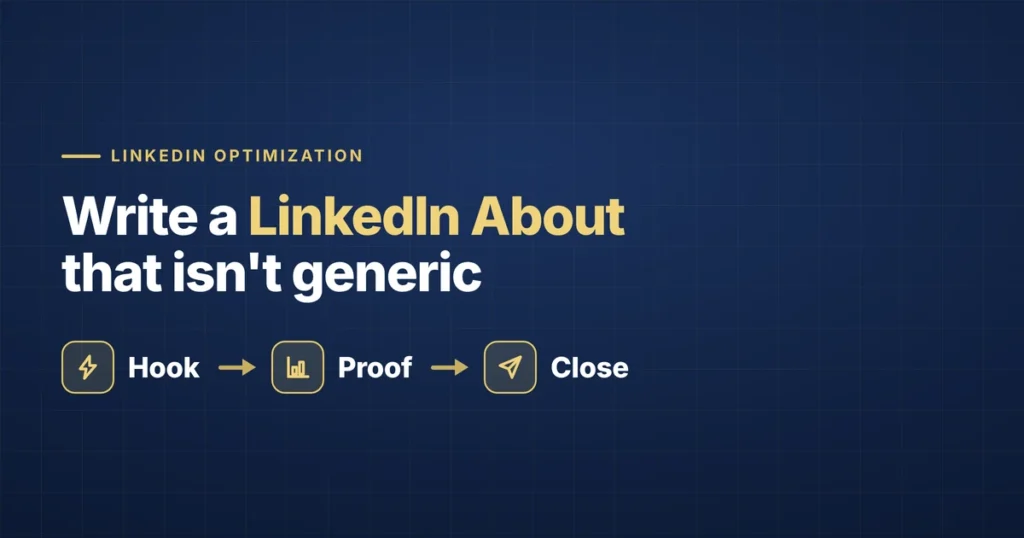
A Structure That Works
Paragraph 1: Who you are and what you do, in concrete terms. (This is your first ~300 characters — make every word earn its place.)
Skip the abstract opener. Start with your role, your specialization, and roughly how long you’ve been doing it. Your most important keywords belong here — naturally, not stuffed.
Example: “I’m a product manager with 6 years of experience building B2B SaaS products, with a focus on cross-functional delivery and data-informed roadmap planning.”
Paragraph 2: A specific accomplishment or two, with real numbers.
This is where vague self-description turns into evidence. Pick one or two genuine results and state them plainly.
Example: “At my last company, I led the launch of a new analytics feature that became our highest-adopted release in three years, growing to 40% of active users within two quarters.”
Paragraph 3: What you’re looking for, or focused on now.
If you’re job searching, say so — clearly, not coyly. If you’re open to the right opportunity but not actively looking, that’s worth stating too, since it changes how a recruiter approaches you.
Example: “I’m currently looking for senior product management roles in B2B SaaS, ideally on a team building tools for technical or operations-focused users.”
Paragraph 4 (optional): A personal or human note.
A single sentence about something outside work — a genuine interest, not a forced quirky line — can be the difference between a profile that reads like a corporate bio and one that reads like an actual person wrote it. Keep it to one sentence.
A Full Example, Put Together
“I’m a product manager with 6 years of experience building B2B SaaS products, with a focus on cross-functional delivery and data-informed roadmap planning.
At my last company, I led the launch of a new analytics feature that became our highest-adopted release in three years, growing to 40% of active users within two quarters. I’ve also built and scaled a quarterly roadmap process now used across three product teams.
I’m currently looking for senior product management roles in B2B SaaS, ideally on a team building tools for technical or operations-focused users.
Outside of work, I’m slowly working through every national park in the western US — currently at 11 out of 19.”
What to Avoid
- Writing in the third person. This isn’t a corporate bio page; write as yourself, in first person.
- A generic opener. “I am a dedicated professional with a passion for excellence” tells a reader nothing — and wastes your highest-weighted About-section real estate.
- Listing everything you’ve ever done. This is a focused pitch, not your resume. Save the exhaustive history for the Experience section.
- Forgetting the keywords. If your About section doesn’t contain the terms a recruiter searching for your target role would type, it’s not pulling its weight in search — no matter how well-written it is. Aim for your target role’s language woven naturally throughout.
- Copy-pasting your resume. A resume is past-tense and written for one role; your About section is an indexed, searchable narrative written to generate inbound interest. They serve different jobs and should read differently.
The Bottom Line
A strong About section reads like a real, specific person describing real, specific work — not a corporate placeholder. Lead with a concrete, keyword-rich opening (those first 300 characters do the most work, for both the algorithm and the human), prove your value with numbers, say what you want, and keep your keywords consistent with your headline. Once you have a structure, it stops being a blank-page problem and becomes a fill-in-the-template one. (Pair this with your LinkedIn headline and the full optimization checklist.)
Frequently Asked Questions
What should I write in my LinkedIn About section?
Use four short paragraphs: (1) who you are and what you do, in concrete terms with your key keywords; (2) one or two specific accomplishments with real numbers; (3) what you’re looking for or focused on now; (4) an optional one-line human note. Write in first person, and front-load keywords in the opening since the first ~300 characters carry the most search weight.
How long should a LinkedIn About section be?
You have up to 2,600 characters. A focused 1,500–2,000 characters across three or four short paragraphs works well — long enough to include specifics and keywords, short enough to stay readable. The most important content goes in the first ~300 characters, before the “See more” cutoff.
Does the LinkedIn About section help with search ranking?
Yes. After LinkedIn’s 2026 update, the first ~300 characters of the About section carry significantly higher ranking weight, alongside the headline. Keywords placed there, and consistency between your About, headline, and experience, help you surface in relevant recruiter searches.
Should I copy my resume into my LinkedIn About section?
No. A resume is a static, past-tense document tailored to one role; your About section is a searchable narrative meant to attract inbound interest from people comparing many candidates. Rewrite it in first person, lead with a hook, and optimize the opening for both keywords and human attention.
Ready to Apply This?
A strong About section is one piece of a profile that gets found — and one piece of a job search that’s a lot of work to run well alone. If you’d rather have your resume, LinkedIn, and applications handled together, that’s what we do. See how it works or get started.