This is almost always the first question in an interview, and it sets the tone for everything that follows — which is exactly why so many candidates either freeze, ramble through their entire life story, or recite something so clearly memorized that it sounds like a script rather than a person talking.
It’s worth getting right for a structural reason, too. While “tell me about yourself” isn’t technically a behavioral question, it behaves like one: it opens the interview and frames how the interviewer hears everything after it. And with behavioral interviewing now the dominant format — companies spend roughly 60% of interview time on it as AI commoditizes technical skills — your opening narrative is effectively the setup for the competency stories that follow.
Why This Question Trips People Up
It feels open-ended, so candidates often treat it as an invitation to talk about anything — childhood, hobbies, an unrelated career detour from a decade ago. The interviewer isn’t asking for an autobiography. They’re asking for a professional narrative that connects your past to the specific role you’re sitting in front of them for.
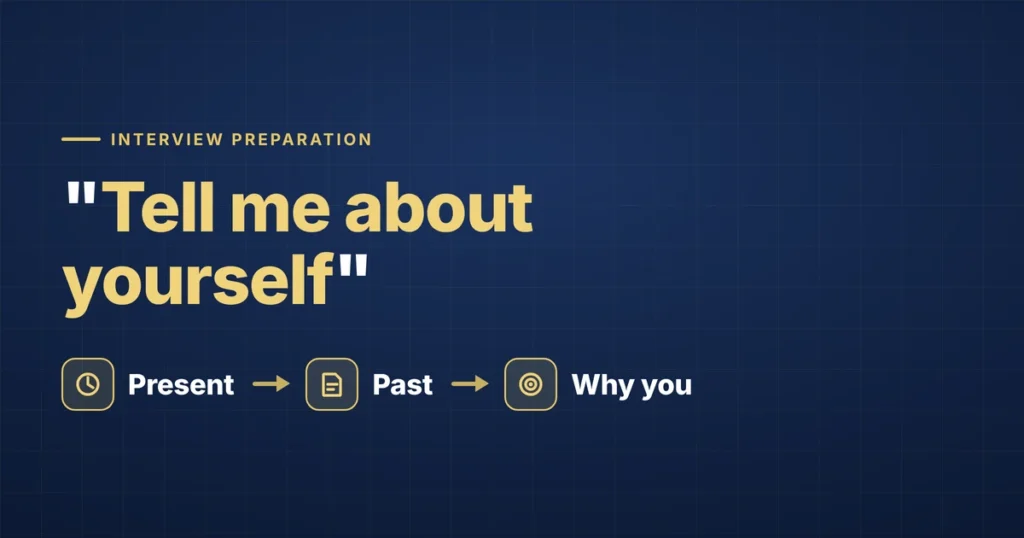
The Structure
Start with where you are now — not where you began. One sentence on your current role or most recent experience.
Bridge to two or three moments that led you here. The skills you developed, the pivots you made, the decisions that shaped your direction — briefly, not exhaustively.
Land on why this role, at this company, right now. Make the connection explicit. Don’t leave it for the interviewer to infer.
Aim for roughly 90 seconds. Long enough to say something substantive, short enough that you haven’t taken over the interview before it’s begun.
A Real Example
Question: “Tell me about yourself.”
Answer: “I’m currently a product manager at a mid-size SaaS company, where I’ve spent the last three years focused on B2B analytics products.
I actually started my career in data analysis, which gave me a strong foundation in understanding what customers actually do with a product, not just what they say they want. That background pulled me toward product management about four years ago, where I could act on those insights directly rather than just reporting them. Since then, I’ve led two major feature launches and built out a quarterly roadmap process that’s now used across three teams.
What’s drawing me to this role specifically is the focus on technical, data-heavy users — that’s exactly the kind of product work I find most engaging, and it’s where my analytics background gives me a real edge over a more generalist PM.”
Why This Works
The structure does three specific things. It opens with the present, not a chronological history starting from college. It includes a deliberate detail — the data-analysis background — that’s relevant to this specific opportunity, not just an interesting personal fact. And it ends by making the connection to the role explicit, rather than trusting the interviewer to draw the line themselves.
Compare it to the weak version: “I graduated in 2022 and have been working in marketing since then.” That’s a timeline, not a narrative — it gives the interviewer nothing to latch onto. Leading with your current role and a concrete focus area immediately signals what you do and why it’s relevant.
What to Avoid
- Starting too far back. Nobody needs your college major from fifteen years ago unless it’s genuinely relevant to the immediate narrative.
- Listing every job you’ve ever had. Pick the two or three moments that actually build toward this specific role.
- Ending without connecting to the role. This is the single most common miss — candidates tell a perfectly good story about themselves and then just stop, leaving the interviewer to guess why any of it matters.
- Memorizing it word-for-word. An over-rehearsed answer reads as stiff and impersonal. Know the structure and key points cold, but let the actual phrasing vary naturally each time.
A 2026 Note: This Opener Is Often on Video
Per SHRM’s 2026 hiring research, about 68% of first-round interviews now happen virtually — and this question almost always opens them. On video, a strong open matters even more because it’s harder to build rapport through a screen. Keep it tight, and when you land your “why this role” finish, look at the camera rather than your own image on the screen — it reads as direct eye contact and makes the close land with more conviction.
Frequently Asked Questions
How do you answer “tell me about yourself” in an interview?
Use three parts: start with your current role or most recent experience (one sentence), bridge through two or three moments that shaped your direction, then land on why this specific role at this company fits. Keep it to about 90 seconds, lead with the present (not your early history), and always end by connecting your background to the role.
How long should your answer to “tell me about yourself” be?
About 90 seconds. Long enough to give a substantive professional narrative, short enough that you haven’t dominated the start of the interview. If you’re running long, your early-career history is probably too detailed — compress it and spend your time on what’s relevant to this role.
What should you not say when answering “tell me about yourself”?
Don’t start with your childhood or distant past, don’t list every job chronologically, don’t recite a memorized script that sounds robotic, and don’t end without explaining why your background fits this role. The most common mistake is telling a fine story but never connecting it to the job.
Is “tell me about yourself” a behavioral question?
Not technically — it doesn’t ask for a specific past example. But it functions like one: it opens most interviews and frames how the interviewer hears your later answers. Treat it as the setup for the behavioral stories that follow, with a clear, role-relevant narrative.
The Bottom Line
“Tell me about yourself” is the most predictable question in any interview and one of the easiest to get wrong. Lead with the present, bridge through a couple of relevant moments, and finish by connecting your story to the specific role — in about 90 seconds, in your own natural words. Getting it right doesn’t guarantee the rest goes well, but getting it wrong makes everything after it harder. (Next, prepare your STAR stories and map them to the common behavioral questions.)
If you’d rather have your entire job search handled — from a tailored resume through to the interview — that’s exactly what we do. See how it works or get started.