Most STAR method guides explain the framework — Situation, Task, Action, Result — without showing what a genuinely strong answer actually sounds like in full. Here are real example answers across common scenarios, along with the structural details that separate a strong STAR answer from a rambling one.
First, why this matters more than it used to. As AI has automated much of the routine technical work, hiring has shifted toward the human skills it can’t replicate — judgment, collaboration, adaptability. The result: behavioral interviews are now the dominant gate. Recent analysis finds companies spending around 60% of interview time on behavioral questions versus 40% on technical. Candidates are now regularly eliminated at the behavioral round after passing the technical screen. The good news in that shift: preparation beats charisma here. Walk in with strong, structured stories and you’ll outperform more “naturally” confident candidates who are winging it.
The Structure, Briefly
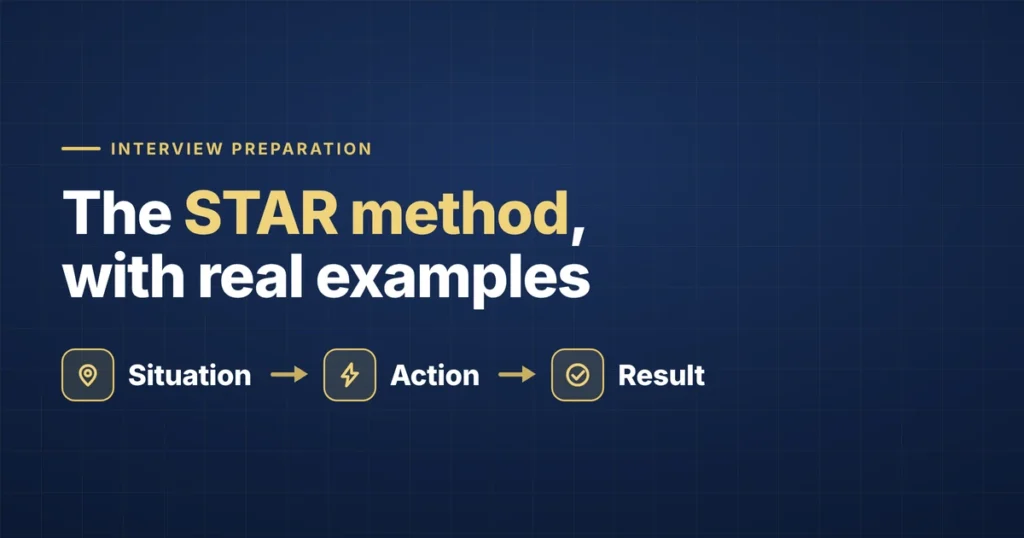
Situation: brief context. Task: what you needed to accomplish. Action: what you specifically did. Result: the measurable outcome.
The detail most people get wrong is time allocation. A strong answer spends roughly 10% on Situation, 10% on Task, 60% on Action, and 20% on Result — and runs about 60–90 seconds total, or roughly 150–200 words spoken aloud. Interviewers start losing focus after about 90 seconds, so if you’re spending more than a couple of sentences setting up the Situation, you’ve lost the thread before saying anything about what you actually did. (This 60% Action emphasis is consistent across interview-coaching guidance from sources like MIT’s career office and major interview-prep research.)
Example 1: Leadership
Question: “Tell me about a time you led a team through a difficult project.”
Answer: “Last year, our biggest client moved up their product launch by three weeks, which meant my team of six had to deliver an entire feature two weeks earlier than originally planned.
I started by breaking the remaining work into daily, rather than weekly, checkpoints, so we could catch slippage immediately instead of discovering it at the end of a sprint. I also identified which two features were genuinely critical for launch versus nice-to-have, and got buy-in from the client to defer the lower-priority ones to a fast-follow release. I personally took on code review for the two most complex components so the rest of the team could focus on building rather than waiting on feedback cycles.
We shipped on the client’s new deadline with zero critical bugs in the first week post-launch, and the client specifically called out the team’s responsiveness in their renewal conversation three months later.”
Example 2: Conflict
Question: “Tell me about a time you disagreed with your manager.”
Answer: “My manager wanted to launch a new pricing page redesign without running it through user testing first, mainly because of timeline pressure from leadership.
I raised my concern directly in our next one-on-one, and proposed a compromise: a smaller, time-boxed test with five users over two days, rather than skipping testing entirely or running a full multi-week study. I framed it as a way to reduce risk without meaningfully affecting the timeline, and offered to run the sessions myself so it wouldn’t add to her workload.
She agreed to the compromise. The testing surfaced a confusing pricing tier structure that we were able to fix before launch, and the redesign ultimately shipped only two days later than the original target — with a noticeably lower support-ticket volume in the first month compared to our previous redesign.”
Example 3: Failure
Question: “Tell me about a time you made a mistake.”
Answer: “Early in a project, I underestimated how long a data migration would take and committed to a deadline without checking with the engineering team first. When the actual timeline came back nearly three weeks longer, I had to go back to the stakeholders and explain the miss.
I owned the error directly rather than deflecting it, explained specifically what I’d missed in my original estimate, and presented a revised timeline along with two options to partially mitigate the delay — including moving up a smaller, lower-risk piece of the migration to ship early as a show of progress.
The stakeholders appreciated the directness and the concrete options rather than just an apology. Since then, I’ve built a habit of getting a rough technical estimate from whoever will actually do the work before committing to any external deadline — and I haven’t had a similar timeline miss since.”
What Makes These Work
Notice each Result includes a specific, concrete detail — a renewal conversation, a support-ticket comparison, a changed habit — rather than a vague “and it worked out well.” If you don’t have exact numbers, directional language works: “cut by roughly half,” “the client renewed,” “significantly reduced.” Just don’t end on the setup; many candidates tell a great story and forget the ending, and the Result is what interviewers are actually waiting for.
Notice too that the failure example doesn’t end on the mistake — it ends on what changed afterward. That’s what interviewers listen for on failure questions. They’re not looking for a flawless record; they’re looking for self-awareness and evidence the lesson stuck. (Interviewers increasingly score answers against explicit competency rubrics, so structure and evidence matter more than narrative flair.)
A 2026 Note: Delivering STAR Over Video
This is newly important. Per SHRM’s 2026 hiring research, around 68% of first-round interviews now happen virtually — so most candidates need to land STAR over video before ever meeting anyone in person. Remote formats make it harder to read whether you’re losing the interviewer, so tighten your Situation and Task even further and get to your Action within about 15 seconds. One specific tip: when you deliver your Result, look at the camera rather than the screen — it reads as direct eye contact and makes your finish land stronger.
A Practical Tip
Prepare more stories than you think you’ll need. Most behavioral interviews include four to six questions (more at firms like Amazon, where behavioral questions appear in nearly every round), so having eight to ten solid, versatile stories ready gives you flexibility to pick the best fit for each question without repeating an example twice in one interview.
Frequently Asked Questions
What is the STAR method?
STAR stands for Situation, Task, Action, Result — a structure for answering behavioral interview questions (“Tell me about a time when…”). You briefly set the scene, state your specific responsibility, describe what you personally did (the bulk of the answer), and close with a concrete, ideally quantified result. It keeps answers focused and easy for interviewers to follow.
How long should a STAR answer be?
About 60–90 seconds, or roughly 150–200 words spoken. Spend most of it (around 60%) on the Action. Interviewers lose focus after about 90 seconds, so keep your Situation and Task brief and get to what you actually did quickly. For pre-recorded video interviews with time limits, be even more concise.
What if I don’t have a measurable result?
Use directional language instead of exact figures: “cut roughly in half,” “significantly reduced,” “the client renewed their contract.” The key is to close with a clear outcome rather than trailing off — an answer without a Result is the most common STAR mistake. For failure questions, end with what you learned and changed.
How many STAR stories should I prepare?
Eight to ten versatile stories that each cover multiple competencies (leadership, conflict, failure, teamwork, problem-solving). Most interviews ask four to six behavioral questions, so doubling that lets you pick the best-fit story per question without repeating yourself. Behavioral-heavy companies like Amazon warrant even more.
The Bottom Line
In 2026, the behavioral round is often where offers are won or lost — and it rewards structured preparation over natural charisma. Build eight to ten real STAR stories, spend most of each answer on your specific Action, always close with a concrete Result, and practice delivering them tightly over video. (Next: nail the opener with how to answer “tell me about yourself”, and map your stories to the top behavioral questions.)
If you’d rather have your whole job search — from a tailored resume to landing the interview — handled for you, that’s what we do. See how it works or get started.